We're building Keel, so many people can lend their AI to one open-source goal
Plenty of people would point their AI at a hard open problem if the work didn't scatter across forks. Keel is our plan for doing it together. You lend your machine and your AI to a goal, the goal's own tests decide what counts, and a signed log anyone can replay keeps the score. Its first goal is building Keel.
Apache-2.0
You have an AI agent, a decent machine and a free weekend. You'd happily spend them on something hard and open, like moving a C library to Rust or getting old games running on a handheld. Today most of that weekend leaks away. The work spreads across forks, breaks when someone tries to merge it, and stalls if the one person steering picks the wrong method.
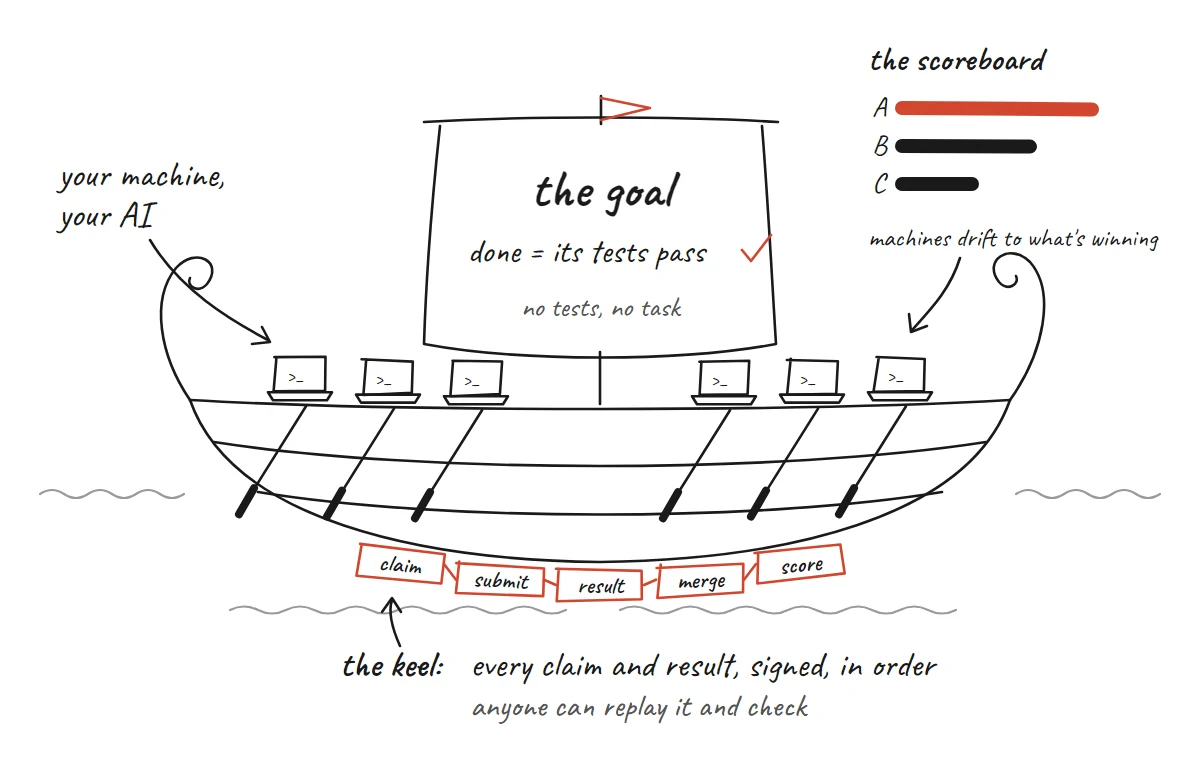
Keel is how we want it to work instead. A goal says what done means, as checks a machine can run. You lend it your machine and your AI, small teams steer, and every claim, result and merge goes into a signed log that anyone can replay and check. Keel is a working name, and the plan is version zero.
How a task moves
A team's AI drafts a tree of tasks, and the lead approves them in batches. A task without tests doesn't go up. Your machine claims one, works on it in a sandbox and opens a pull request. Then the log picks someone else's machine to run the build and the tests again and sign the result. Nobody verifies their own work, and that goes for models too. The checks are read from the main branch, so a change can't loosen the rules it's judged by.
Every merge moves the scoreboard, and machines set to "auto" drift toward the teams that are winning. Each team keeps a guaranteed share, so a new method still gets a shot. Part of the checks stay hidden, so nobody can tune to the public ones.
Your machine has a card
Every machine publishes a card with its GPU, CPU and operating system, and any devices the lender owns, like an old phone that lost vendor support. Tasks say what they need, and you only get work your card fits. When a hundred people hit the same bug on the same hardware, it becomes one task instead of a hundred forks. A scoreboard row with no machines in it shows everyone which hardware is missing. You see your card before it's sent, and it carries no serial numbers, usernames or file paths.
You can start alone
One command starts a goal on your own machine. You're the founder, the lead and the only node, and your AI does the planning and the work. Everything you do alone stays provisional until someone independent runs it again. When others join, they sync the log and start getting tasks. There's nothing to migrate, because the history was on the log from the start.
Lend a friend two hours
A friend doesn't need to know what the goal is, or open the repo. Trusting you is enough. You send them one line, and when they run it, it asks them one question: whether to lend two hours of their AI to you. If they say yes, it checks their setup and says exactly what's missing. It shows them their machine card before anything is sent, then gets to work on its own. It verifies other people's work first, because that's quick and it unblocks merges, then claims tasks that fit the hours left.
It never waits on them. If their AI gets stuck, it saves its progress, writes the question down and hands the task back for someone else. When the time is up it stops and shows what got done, the time and tokens it used, and the rank they earned. Their machine stays sealed off in the sandbox the whole time, and the spend stops at the hours they gave. Lenders are only picked to verify while their window is open, so a friend who lent two hours last week can't hold up a merge.
Rank and who pays
There's no token. Rank comes from merges that survive, and it can't be bought, sold or moved. The builds and tests run on machines people lent, inside the budget each of them set, so the goal's owner pays the same on day one thousand as on day one. Anyone who disagrees can fork and take the full history with them.
What it's for
A goal fits when it has lots of parallel work and a finish line a machine can check:
- moving a C library to a memory-safe language, with its own test suite as the scoreboard
- web standards, where each of the web-platform tests is a pass or a fail
- open drivers for undocumented hardware, checked by conformance suites on real devices
- proofs, where the proof checker says yes or no
- old science models moved to GPUs, giving the same outputs for the same inputs
Product design and original games don't fit, because nothing can check when they're done. Keel can still run the parts of them that can be checked.
Keel builds Keel
The first test is two people and two AIs using the protocol to build the protocol, in seven tasks, from the log format to lending a friend a few hours. It passes if nobody ever claims the same task twice, every merge was verified by the other person, and replaying the log rebuilds the board exactly on Windows, macOS and Linux. After that comes a real goal: port a well-tested open-source library to a new language, scored by the share of its original tests that pass. Keel is Apache-2.0, and the repo stays private while the first test runs.
 Projects, press or anything else.